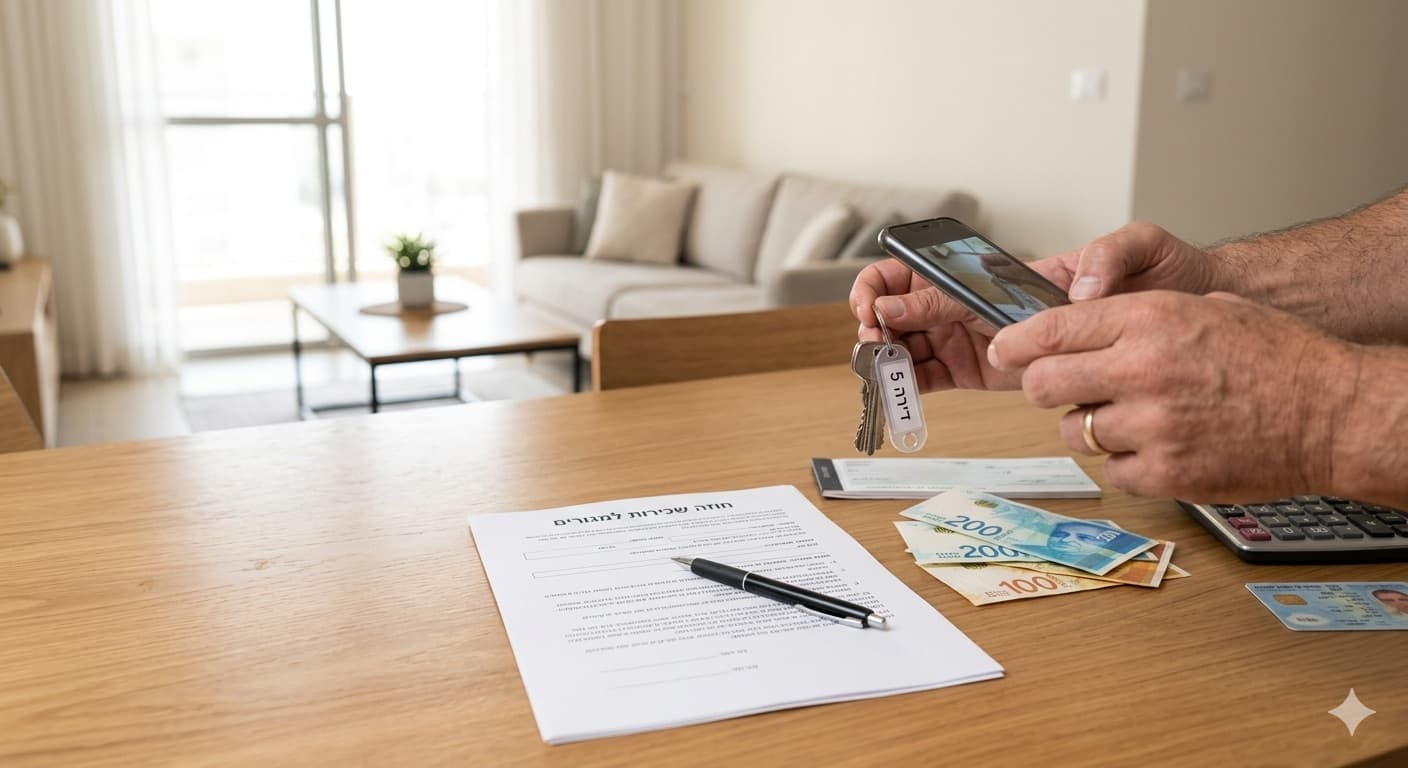

Most lease extensions in Israel happen in a short conversation: "Are you staying?" "Yes." "Great, let's make it 200 more." And then nothing is put in writing, until a problem surfaces — and both sides discover they don't actually know which document they're living under.
Done properly, an extension is a half-hour job, not a two-week one. But it does require checking three things before signing anything: what the existing contract already says, what happens to the securities, and which document you actually need. This guide covers all three.
First question: an option, or an agreement?
This is the first thing to establish, and it determines everything that follows. Open the existing contract and look for an option clause. Is there a right to extend? For how long? And by when must notice be given?
There is an option
The contract already gave the tenant the right to extend. The landlord doesn't need to agree again — all that's needed is written notice within the window the contract sets, typically 60 to 90 days before the end. Notice in time means the extension holds, even if the landlord has changed their mind.
There is no option
Extending depends on both sides agreeing. Nobody owes anybody anything: the tenant can leave, the landlord can ask for more. You negotiate, and whatever is agreed goes into a signed annex.
The trap that costs the most money
If there is an option and you missed the notice deadline, it has lapsed. Not "almost", not "roughly". From that moment the landlord isn't obliged to extend on the agreed terms, and if the market moved up in the meantime, you pay the difference. Put the notice date in your calendar the day you sign the contract — not a month before it ends.
Do you need a new contract? Almost never
Here's the common mistake: opening a Word file and drafting a fresh contract from scratch. Usually it's unnecessary, and sometimes harmful — because every redraft is a chance for a clause that protected you last time to quietly disappear. Instead, a one-page extension annex attaches to the existing contract, extends the term, updates the rent, and states that everything else stays in force.
You can download a free lease extension annex in Word and PDF — along with a ready-to-send option-exercise notice, covering both scenarios above.
When a new contract IS worth it
- •The number of tenants changesA flatmate leaves, one joins, or a single tenant becomes a couple. A change in who the parties are is a material change.
- •The securities change structurallyMoving from a promissory note to a bank guarantee, adding a guarantor, or releasing an existing one.
- •The purpose of the tenancy changesFor example residential turning into mixed use. That's no longer the same deal.
- •The original contract is simply badIf critical clauses are missing, extending it only entrenches the problem. This is your opportunity to replace it.
The securities: the clause everyone forgets
This is the important part of this guide. A promissory note, guarantors and a guarantee deed given for the original contract do not carry over by themselves to an extended period. The annex has to say explicitly that they remain in force to secure the obligations of the new period.
Without that clause you can find yourself in an extended tenancy with securities of doubtful validity — precisely the situation the securities existed to prevent. And if you raised the rent, it's worth checking the promissory note still fits: a security sized against ₪6,000 rent covers you less well when the rent is ₪7,700.
Who signs the annex
Everyone who signed the original contract — guarantors included. A guarantor who didn't sign the annex can argue their guarantee ended with the original term, and that's a hard argument to counter.
How much can the rent go up?
For unprotected tenancy, Israel has no statutory cap on rent increases — the figure is agreed between the parties. But two things do constrain it:
What actually binds
The option clause in the contract
If the contract fixes the rent for the option period, or sets an indexation formula (for example linked to the CPI), that clause binds both sides. You can't reopen it just because the market moved.
Mid-term: not allowed at all
A unilateral increase in the middle of a tenancy isn't possible. Rent is set for the whole contract term and changes only on an agreed extension, or as the contract itself provides.
Beyond that, it's a negotiation. And it's worth remembering the arithmetic landlords sometimes miss: one month of an empty apartment costs more than the gap between ₪7,400 and ₪7,700 across an entire year. A good tenant who looks after the place and pays on time is worth more than an aggressive increase that pushes them to start looking elsewhere.
With a LeaseLink contract, renewing for the same tenant is free
The tenant who stayed seven years with no updated paperwork
This is more common than it sounds: a contract signed in 2019, the tenant stayed, the rent was updated twice over WhatsApp, and nobody has signed anything since. The tenant has not become a protected tenant — time alone doesn't create protected tenancy, as we explained in the guide to unprotected tenancy leases. But the real risk is elsewhere.
What actually happens when there's no document
Step 1
Damage is found in the apartment. The landlord says it happened during the tenancy; the tenant says it was there from the start. There's no updated contents annex and no condition record.
Step 2
The landlord wants to enforce the promissory note. The tenant argues the note was given for a contract that ended in 2020, and that a new, unrecorded arrangement has applied since.
Step 3
The actual rent is ₪7,700, but the only written contract says ₪6,000. In a dispute, the document is what counts — not the bank transfers.
The outcome
Two years of verbal understandings turn into a year of wrangling. One signed annex a year would have prevented all of it.
Extension checklist
- 1.You checked whether there's an option and when notice is dueAnd if there is — you gave written notice in time and kept proof of delivery.
- 2.You agreed the period and the rent in writingEven an email. The annex should record an existing agreement, not create a new argument.
- 3.The annex includes a continuing-securities clausePromissory note, guarantors and guarantee deed — explicitly, not by implication.
- 4.Every party signed, guarantors includedA guarantor who didn't sign the annex is a guarantor whose guarantee can be challenged.
- 5.You updated the payment method for the new period and amountNew cheques or an updated standing order. The old amount will come back as a problem.
- 6.Each side kept a signed copyWith a digital signature this happens automatically, audit trail included.
Frequently asked questions
- Does an extension annex need a lawyer or a notary?
- No. An extension annex for a residential lease doesn't require a lawyer's or notary's certification. It requires signatures from every party who signed the original contract, guarantors included. Notarisation is needed for other kinds of documents, not this one.
- Can a lease be extended over WhatsApp?
- An agreement in a message thread may well be legally valid, but it's a poor document: it doesn't carry the rest of the contract's terms, says nothing about the securities, and in a dispute has to be reconstructed from a chat log. If you've already agreed over WhatsApp, good — that's the starting point. Now move it into a signed annex.
- What if the tenant stays and we never signed anything?
- You end up with a tenancy continuing in practice on the original contract's terms, which is a common source of disputes over rent, over the vacate date, and over whether the securities still hold. It doesn't create protected tenancy, but it does weaken both sides' positions. The fix is an extension annex, even after the fact.
- How far ahead should the process start?
- If there's an option, per whatever the contract says — usually 60 to 90 days before the end. With no option, it's worth opening the conversation around 90 days out, so there's real time to negotiate and to find an alternative if you can't agree. A conversation that starts two weeks before the end is a conversation held under pressure.
- Can an extension annex be signed digitally?
- Yes. A secure digital signature on an annex is valid under Israel's Electronic Signature Law, 5761-2001, exactly as on the contract itself. If you have the annex as a PDF you can upload it and send it out for signature to every party, guarantors included, with no printing and no meeting.
In short: a good extension is one document, signed on time, that states explicitly what changes and what stays. Start from our free extension annex — and if you're building a new contract anyway, it's worth reading how digital lease contracts save you this whole round-trip next year.