
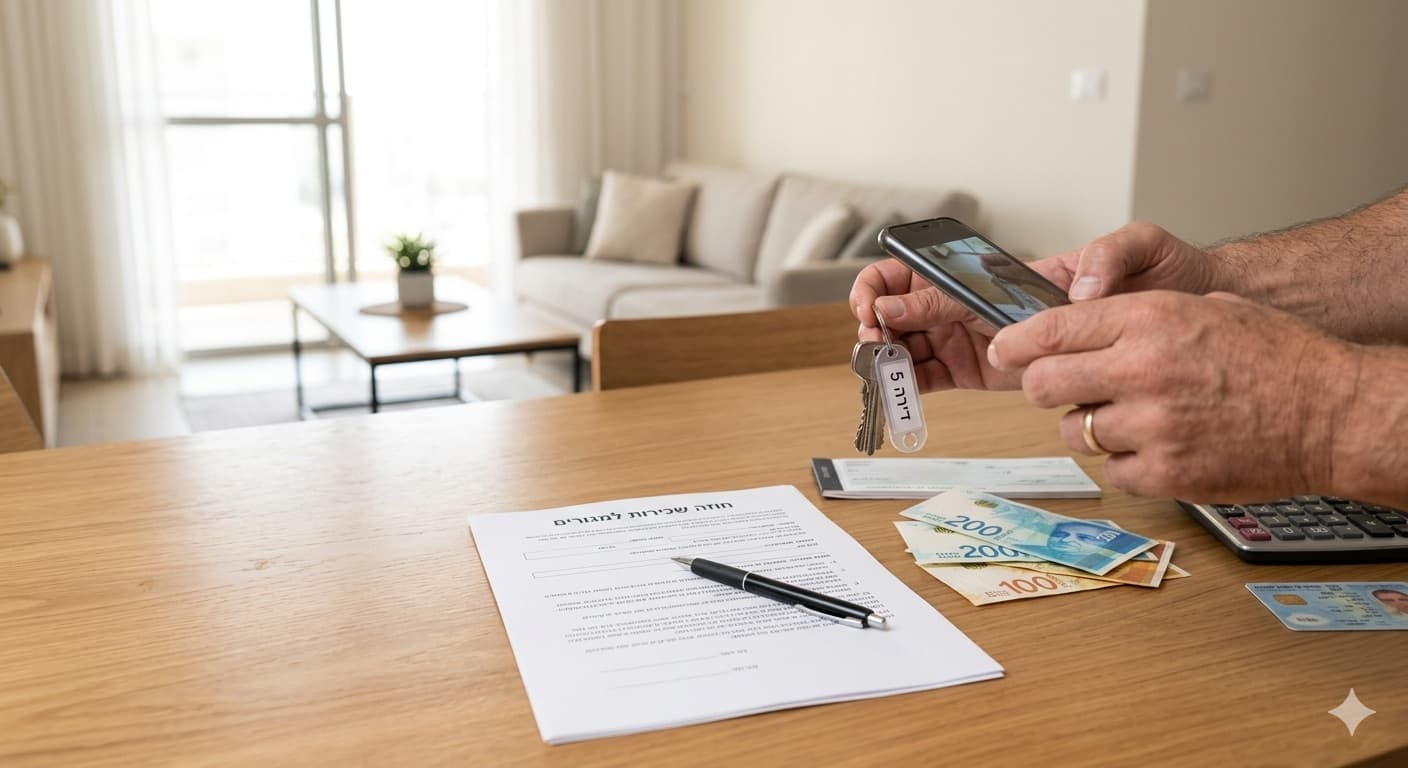
Yossi from Petah Tikva found a nice couple to rent his apartment, shook their hands, and signed a generic Word document he had quickly downloaded from Google. Six months later, when the tenant stopped paying rent, Yossi finally consulted a lawyer and reality hit him hard: an emailed signature isn't legally robust enough to verify identity, the contract lacked a clear eviction clause, and the security check he took bounced. The apartment sat empty for months while the complicated legal process drained Yossi's energy and wallet.
Did you know?
Industry estimates suggest over 70% of independent landlords in Israel use standard templates downloaded from the internet. Meanwhile, evicting a non-paying tenant without explicit contract clauses can take anywhere from 6 to 12 months in the Israeli legal system.
If you're managing your own rental property, you simply have to know exactly what goes into your contract and how to properly execute it. A strong contract won't magically prevent every issue from arising, but it will absolutely give you the legal leverage and practical tools to resolve problems quickly and effectively.
What must be in an Israeli lease contract
Before the clauses landlords miss, make sure the basics are there. These are the details that appear in every residential lease in Israel, and they are what turns a document into a contract you can actually enforce.
The 11 building blocks of a valid lease
- 1.Party detailsFull name, ID number and address for the landlord and for every tenant. A contract missing full identification of a party is very hard to enforce.
- 2.Property descriptionFull address, floor, number of rooms, and exactly what is included: parking, storage, balcony, furniture and appliances.
- 3.Lease termPrecise start and end dates. Without a clear end date you have no move-out date to hold anyone to.
- 4.Rent and payment dateThe amount in shekels, the day of the month it is due, and the payment method. This is also where you set what happens on a late payment.
- 5.Ancillary chargesMunicipal tax, building committee, water, electricity and gas. Spell out who pays what, because this is one of the most common sources of disputes.
- 6.SecuritiesDeposit and security cheque: the amount, when they are returned, and when they may be drawn on. The Rental and Loan Law caps monetary securities in residential leases at the lower of one third of the rent for the whole term or three months of rent.
- 7.Tenant Protection Law exclusion clauseThe clause establishing that the tenancy is unprotected. Without it you may end up facing a tenant with rights you never meant to grant.
- 8.Maintenance and repairsWhat the landlord is responsible for, what the tenant is responsible for, and how quickly a fault reported in writing gets handled.
- 9.Renewal optionIf there is an option: how far in advance it must be exercised, and what the rent will be during the extended term.
- 10.Breach and evictionWhat counts as a breach, how many days there are to cure it after written notice, and what happens if it is not cured.
- 11.Signatures from every partyA signature from every landlord and every tenant. A verified digital signature is valid in Israel under the Electronic Signature Law, 5761-2001, and is easier to evidence than ink on paper.
The basics are only the basics
This list is what makes a document a contract. What separates a contract that holds from one that collapses are the clauses in the next section, and most private landlords miss them.
Why downloading a random contract is a ticking time bomb
It's highly tempting to search for a 'free lease agreement' or simply use the 'Tel Aviv municipality lease contract' and call it a day. The real danger is what you don't see in those documents and the critical protections you are missing. Does the template have a quick exit clause that leaves you with an empty apartment in the middle of winter, or are the security deposit conditions worded in a way that legally prevents you from cashing them when you actually need to?
The snowball effect of a bad contract
Here is exactly how a small issue becomes a massive nightmare without proper legal backing:
Day 1
The tenant is late on rent, but your generic contract doesn't clearly define late fees or breach conditions.
Day 15
You try to cash the guarantor note (Shtar Chov), only to realize the template you used is outdated and invalid at the execution office.
Day 45
You demand eviction, but the tenant uses the lack of a clear eviction mechanism in your contract to drag you into a lengthy court battle.
5 Crucial Clauses Landlords Often Miss
The ironclad rules of your lease
Explicit Eviction Mechanism
What exactly happens upon breach of contract? Without it, everything stalls. You need to clearly define the timeline: Breach → Written notice with X days to remedy → Immediate eviction, and ensure your contract qualifies for Israel's fast-track eviction procedure.
Teeth in Your Security Deposit
A standard security check can easily bounce or be cancelled, so you should demand cash, a bank guarantee, or a certified digital guarantee service to act as your financial oxygen when things go wrong.
Clear Boundaries for Repairs
Write it down plainly so there's no confusion: normal wear and structural infrastructure are the landlord's responsibility, while damages caused by the tenant's negligence fall directly on the tenant.
Exit Terms and Replacements
If a tenant wants to break the lease early, your contract must stipulate that they are responsible for finding a suitable replacement approved by you, and that they must pay rent until that new tenant moves in.
Rent Increase Mechanism
If you leave this out, you have no automatic right to raise the rent upon renewal, so be sure to include a clause that anchors the rent to the Consumer Price Index (CPI) or sets a percentage increase for the option period.
The Signature Trap and Document Management
Here is a major detail most independent landlords miss: having a tenant print, sign, and email back a PDF is highly vulnerable in court. Without proper authentication, it is simply far too easy for a tenant to claim they never actually signed the document.
Comparing Contract Signing Methods
Scanned & Emailed
Convenient, but lacks verified identity proof and holds very weak legal standing if a dispute ever goes to court.
In-Person Lawyer
Provides ironclad legal validity, but requires complex scheduling, travel, and significant legal fees for all parties.
Verified Digital Signature
Cryptographically verifies the tenant's identity and IP, is fully legally binding, and can be done from any smartphone in minutes.
Want a contract that covers all of this?
Documenting the Entire Lease Portfolio
A lease isn't just one piece of paper—it's an entire ecosystem of crucial information. Don't leave documents scattered across emails, WhatsApp chats, and physical drawers. Make sure that all ID copies, tenant payslips, guarantor notes, and addendums are properly documented and safely stored together in one centralized place.
Documenting the Property Condition
Three years from now, neither you nor your tenant will remember if that scratch on the floor was already there. On handover day, photograph everything—every room, every wall, and every existing defect—and attach these photos to a formal handover protocol signed by the tenant to save yourself countless arguments.
The Smart Organization Tip
By the way, on the LeaseLink platform, you can easily take photos of the apartment and upload all visual evidence and the handover protocol directly as addendums to your secure digital contract, keeping everything perfectly organized for the day you might need it.
Tenant Screening: You're Handing Over a Million-Shekel Asset
Too many landlords rely on a simple gut feeling because the applicants seem friendly, but friendliness doesn't pay the mortgage during an economic downturn, which makes rigorous screening absolutely non-negotiable.
Mandatory checks before handing over the keys
Income Verification
Always ask for the last 3 payslips and follow the standard rule that their net income should be at least 3 times the monthly rent.
Credit History
Ask the prospective tenant to produce a free personal credit report (BDI) from the Bank of Israel's credit data system.
Previous Landlords
Don't skip the reference call; ask directly if they paid on time and in what condition they left the property.
Check the Guarantors
Vet the guarantors just as strictly as the tenants themselves because they are your ultimate financial safety net.
The Bottom Line
Skipping a professional contract to save a little time now can cost you thousands of shekels and endless stress later.
Never use free internet templates without verifying they contain strong eviction, security, and maintenance clauses.
An emailed signature offers weak legal protection, so it is highly recommended to switch to verified digital signatures and centralize your documents.
Document the property's condition and screen your tenants as if your business depends on it—because it absolutely does.
Lease contract FAQ
- What must be in an Israeli lease contract?
- Party details and ID numbers, a full description of the property and what is included, start and end dates, the rent and its due date, how ancillary charges are split, securities, the Tenant Protection Law exclusion clause, the split of maintenance and repair responsibility, a renewal option if there is one, a breach and eviction mechanism, and signatures from every party.
- Does a lease contract have to be signed by a lawyer in Israel?
- No. A residential lease is valid once the parties have signed it, and there is no legal requirement for a lawyer to draft or witness it. What matters is that the contract contains the substantive clauses and that the signature can be evidenced if a dispute arises.
- Is a digital signature on a lease contract valid in Israel?
- Yes. The Electronic Signature Law, 5761-2001 recognises electronic signatures, and a signature verified by a one-time SMS code creates a record of who signed, when, and from which device. That is stronger than emailing a scanned file, which is hard to tie to the signer.
- How many pages should a lease contract be?
- There is no page requirement. A standard Israeli residential lease is usually 2 to 4 pages, and that is enough as long as every substantive clause is in there. Length is not a substitute for content: a 12-page contract with no clear eviction clause is weaker than a 3-page one that has it.
- How large a deposit can a landlord take in Israel?
- The Rental and Loan Law, as amended by the Fair Rent amendment, caps the monetary securities a landlord may require in a residential lease at the lower of one third of the rent for the whole term or three months of rent. There are exceptions, and the cap does not apply to non-residential leases.
Ready to create a professional, legally robust lease contract? Get started now — LeaseLink builds contracts with verified digital signatures, complete document management, and cloud storage. No lawyers, no sketchy downloads. You can also download a free standard lease template and fill it in by hand — and read what unprotected tenancy means and tenant rights in 2026 first.